A Brief History of Digital Transformation

There have been several waves of technological change that have influenced the current wave of digital transformation. In the 1990s, the implementation of Enterprise Resource Planning (ERP) systems significantly impacted back office operations. In the early 2000's, the Internet revolutionized the way customers interacted with organizations. Smartphones and Social Platforms further revolutionized how organizations communicate and deliver service.
MIT Sloan Management Review conducted research that indicated that organizations who were early adopters of digital technology primarily focused on improving isolated areas. As organizations continued to implement these digital tools over time, it became apparent that implementing isolated improvements resulted in inefficiencies.
For example, a Customer Relationship Management System could collect data, however, if that data was not connected to operational functions or analytic capabilities, then the positive effects of the CRM would be limited.
Cloud computing made possible the acceleration of the above mentioned trend. According to Gartner, while scalability and flexibility are supported by cloud computing, they cannot be achieved unless accompanied by a redesign of processes. As digital ecosystems expanded, organizations realized that transformation was no longer an activity limited to individual projects, but rather needed to be coordinated among various departments.
Realizing this, organizations have started using a larger scope for their definition of digital transformation. The new definitions include:
- A new way to build a business model
- An integration of the data of different departments
- Empowerment of employees through digital means
- Improved agility and resilience
Thus, the focus of discussion on digital transformation shifted from the technical implementation (technology) to organizational change.
What Digital Transformation Means
Digital transformation refers to the integration of digital technologies throughout a business, which results in substantial changes to how the organization works and generates value. As stated in the definition, this is an integration, and not just adding something new to what already exists.
There are several connected components to digital transformation. These include:
- Redesign of processes
- Change of culture
- Decision making based on data
- Integration of technology
- Alignment of leadership
Each component impacts other components of transformation. Therefore, if any component is neglected, the speed at which transformation occurs will slow down.
Process Redesign: Rethinking How Work Gets Done

In many cases, digital transformation starts with the examination of processes within an organization. Organizations look at how work flows from department to department. They determine where there are bottlenecks, redundant tasks, and manual tasks which are slowing their performance.
Automation, without a redesign of processes, may actually create a faster version of the same problems. Thus, simply automating an inefficient or poorly designed process will result in the same issues as before, albeit faster.
When redesigning processes, many organizations follow similar steps:
- Map current workflow processes
- Identify repeated manual tasks
- Remove the need for manual approval layers
- Standardize documentation
- Ensure that the redesigned processes meet customer needs
For instance, an organization implementing digital invoicing, must also review its approval chain, and reporting structure. Simply implementing a piece of software does not ensure that it will lead to improved efficiency.
Redesign of processes, promotes simplicity. It identifies who makes decisions, and how information is exchanged. In the long run, clarity provides organizations with better agility, and allows them to respond to shifts in the market, much quicker than organizations with unstructured processes.
Cultural Shifts: The Human Dimension
A company's organizational culture must be receptive to change, or technology will not bring about transformative change within the organization. The Harvard Business Review has stated that the most successful digital transformations occur as a result of leaders creating environments where employees can experiment, learn and innovate while being transparent throughout the process.
The process of changing an organization's culture includes:
- Cross functional team work
- Continuous learning opportunities for all employees
- Reducing the employee's fear of failure
- Developing systems which reward innovative ideas and actions
All employees must clearly understand the purpose behind the changes. Communication is key. The goal must be clearly communicated by the leader and demonstrated by the leader's actions.
Hierarchical structures in organizations typically hinder fast decision making. With digital transformation comes the empowerment of distributed authority. The teams that are close to the customer typically have access to the most relevant data regarding the customer. As a result, those teams make decisions much faster.
Creating a digitally transformed culture takes time, patience and consistent effort. If it doesn't occur, then new technologies remain unused.
Data-Driven Decision Making
One of the primary characteristics of digital transformation is the utilization of data in the strategic decision-making process. According to McKinsey, companies that utilize analytics to inform their strategies outperform their competitors in terms of both profitability and productivity.
Organizations that are focused on using data to drive their decision-making processes focus on the following items:
- Collecting quality data
- Creating a unified source of data
- Utilizing analytical tools to identify patterns in the data
- Incorporating insights derived from the data into daily decision-making processes
However, collecting data is one thing; utilizing that data to create actionable insights is another. To ensure that the data created is used appropriately, governance structures must exist. Clearly defined roles and responsibilities must also exist in order to hold employees accountable for maintaining the integrity of the data collected and to maintain the security of the data collected.
Technology Integration: Platforms that Connect
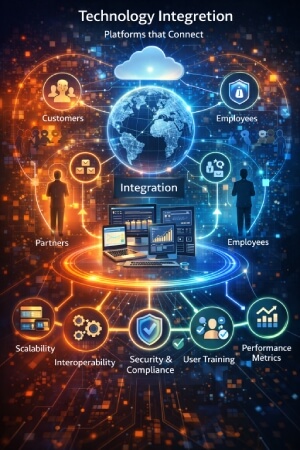
Technology is central to the process of transforming an organization. Technology can be defined by the use of the cloud, artificial intelligence (AI), enterprise software and collaboration tools which support the transformation of an organization through providing the appropriate infrastructure.
Digital platforms are ecosystems that link customers, partners, and employees. In addition, integration of information enables seamless flow between different systems and/or departments. Without integration, different departments will continue to function in silos.
A successful technology implementation will usually include:
- Selecting scalable platforms.
- Ensuring compatibility between systems (i.e., interoperability).
- Prioritizing security and compliance.
- Investing in user education/training.
- Monitoring relevant performance metrics.
In summary, the ultimate goal of the integration of technology into an organization is to create a coherent environment where various tools complement one another instead of competing. By creating a coherent environment, organizations become more flexible.
However, it is worth noting that with each additional tool or system added to an organization there is increased complexity. Therefore, organizations that have successfully integrated technology into their organizations focused on creating clarity before adding layers of functionality and they clearly defined their organizational needs prior to implementing new technologies and did not implement technology based on trends.
Leadership and Strategic Alignment
Transformation is driven by leadership's vision and commitment to change. Research has demonstrated that organizations with strong executive sponsorship experience higher levels of digital maturity.
Strategic alignment refers to:
- Establishing measurable objectives.
- Linking digital initiatives to an organization's business strategy.
- Appropriately allocating resources to meet those objectives.
- Establishing governance frameworks.
Leadership must articulate a unified message in order to promote employee engagement. If digital projects appear to be unrelated to an organization's core mission/strategy, engagement will decline.
Accountability is also necessary when undergoing transformation. Accountability is achieved by establishing clear metrics and tracking the success/failure of initiatives. Transformation leaders should continually review results and make adjustments to strategy as warranted.
Common Misconceptions
Digital Transformation is generally misunderstood. Common misconceptions are:
- That it is a single project
- The project will be solely managed by the IT Department
- Only Customer Facing Tools are needed
- There will be instant Results
However, in actuality, transformation is an ongoing process. Technology changes. The market changes. Customer expectations change. And, organizations must make repeated adjustments.
Another misconception is that transformation requires large budget investments. While budgetary investment is important for transformation, what is most important is how well you plan, prioritize your projects and utilize strategy to achieve incremental success.
Challenges and Barriers to Transformation
Research conducted by McKinsey has identified several barriers to transformation that organizations may face:
- A lack of a clear vision
- Employee resistance to change
- Employees lacking the skills required for transformation
- Data Systems are fragmented
- Inadequate or non-existent Governance
To overcome the challenges and barriers associated with transformation requires planning and decision-making. To mitigate employee skill gaps, training programs can be implemented. Employee resistance to change can be reduced by providing employees with clear and transparent communications about the need for change. Adequate governance structures can provide organizational accountability.
Additionally, transformation also brings with it risks. As companies have expanded their digital footprint, so too have the cybersecurity risks associated with them. Furthermore, as the complexity of digital transactions increases, so too does the complexity of compliance regulations. Companies must find a way to continue to innovate while managing those risks.
Measuring Digital Maturity
Assessing an organization's digital maturity is also an essential part of measuring the effectiveness of its transformation efforts. A number of digital maturity models exist which assess an organization's digital maturity along various dimensions such as leadership, culture, data capability and technology integration.
Examples of indicators of digital maturity:
- An integrated platform across all departments.
- Real-time performance metrics displayed on dashboards.
- Agile project methodologies utilized to manage projects.
- Collaboration and alignment among functional areas.
- Design processes centered on the needs of the customers.
The measurement of digital maturity provides an opportunity for reflection on where an organization has been and where it still needs to go. Measurement of digital maturity highlights both the positive attributes of an organization (its strengths) and the negative attributes of an organization (its weaknesses). Ongoing measurements of digital maturity support long-term and sustainable growth.
Clarity Before Complexity
One of the most consistent themes throughout research and case studies is that organizations who clearly define their objectives prior to implementing new technologies are likely to realize greater results than organizations who do not define their objectives until after they implement new technologies.
Clear objectives involve:
- Identifying the specific business problems to be addressed.
- Prioritizing initiatives based upon potential for impact.
- Aligning all stakeholders toward a common goal.
- Establishing measurable benchmarking criteria.
A major challenge for many organizations is creating clarity within a complex system. However, when teams clearly understand the reasoning and justification for transformation, team members are more engaged and motivated. Teams view technology as an enabler rather than as an obstacle to achievement.
The Digital Transformation Requires Ongoing Training
Digital transformation requires a continuous education, as new technologies emerge with new platforms and analytics tools. A company that invests in employee education can develop its own internal capabilities for resiliency.
Some examples of what this education may look like:
- On-line certifications
- Knowledge sharing within the organization
- Workshops that focus on different aspects of business (cross functional)
- Leadership Development Initiatives
Education builds confidence. Education reduces your dependence on outside consultants. As you continue to learn, you will increase the capability of your organization.
The Bottom Line
Transformation in the digital age represents a complete overhaul of how businesses function. This includes; Process Redesign, Cultural Change, Decision Making based on Data, and Integration of Technology into existing processes. All research and reports from institutions such as McKinsey, Harvard Business Review, Gartner, and Deloitte, consistently emphasize that technology alone cannot create transformation.
Transformation is dependent upon alignment.
Employees need to understand the companies' strategy. Employee's processes should be agile. Data needs to be used to make decisions. And all platforms need to be able to connect easily.
Businesses that approach transformation with a clear vision of their future are much better equipped to manage complexity, to react more quickly to change or disruption and to build systems that will adapt rather than fail when subjected to stress or disruption.
Transformation in the digital age continues to evolve. Value will be found in the discipline of implementation and the thoughtfulness of design. When employees, processes and platforms are aligned, a business has created a foundation for sustainable success in a digital environment.