The Meaning of Digital Transformation

In many ways, Digital Transformation can be thought of as integrating digital technology throughout a company. Gartner defines Digital Transformation as a "fundamental change in how organizations deliver value to customers by using digital technologies." While this may involve a single project or software upgrade, it represents a fundamental shift in mindset and operation.
At its core, digital transformation involves three elements:
- Reworking internal processes using digital tools
- Improving customer experience through technology
- Developing new business models enabled by digital platforms
Many organizations have operational upgrades when they first start out. First, they transition from paper-based systems to digital workflow. Next, they will implement enterprise resource planning (ERP) software to better manage their internal operations. Finally, they may implement some sort of collaboration tool to help remote teams work together more effectively. As an organization grows, it begins to shift its focus toward customers. The customer portal, mobile app, or even the personalized service experience becomes a major factor in how fast an organization can grow.
Commitment from Leadership is Required for Digital Transformation
Harvard Business Review recently wrote about how most successful digital transformations were driven by clear strategic goals rather than just another IT initiative. In other words, technology must be used to achieve a specific business goal.
Competitive Positioning through Technology
The way technology affects competitive positioning today is quite significant. Organizations that are able to leverage data and automation more effectively than others, can react to changes in the marketplace much quicker than organizations using manual processes.
Infrastructure Management via the Cloud
Cloud computing has dramatically changed the way organizations manage their infrastructure. According to the International Data Corporation, spending on cloud computing is growing at a rate of year over year. Rather than having to maintain their own physical servers, organizations use cloud service providers to host applications and to store their data. Benefits of using Cloud Computing include:
- Reduced cost of infrastructure
- Flexibility to scale up or down based on peak demands
- Ability to improve disaster recovery capabilities
- Ability to provide remote access to distributed teams
Organizations can also rapidly deploy services on cloud platforms like AWS, Azure, and GCP. These flexible platforms allow organizations to test new ideas and drive innovation.
AI and Automation
In addition to being tested in research laboratories, artificial intelligence is now being implemented throughout many organizations. AI systems are used to process massive amounts of data and find patterns within that data to aid in decision-making. The World Economic Forum states that the adoption of AI is increasing across multiple industries, such as healthcare, financial services, retail, and manufacturing. These are some examples of how AI is being implemented today:
- Using AI to power customer service chatbots
- Implementing predictive maintenance in manufacturing environments
- Implementing fraud detection in banking environments
- Providing personalized product recommendations in retail environments
Automation aids AI by minimizing repetitive operations that would otherwise be completed manually. Automation through robotic process automation (RPA) enables organizations to automate the most repetitive forms of administration work — for example, processing invoices or entering data. RPA also enhances data accuracy and decreases organizational operating costs.
Data as an Asset

The modern organization generates large volumes of data. Each transaction, each click on the web and every interaction generates data. As stated by IBM, organizations that use their data to inform decisions regarding customer acquisition and retention are more likely to do so.
Analytics enable the transformation of raw data into insight. Reporting tools and dashboards are used to provide business users access to performance metrics in real-time. Instead of using intuition to make decisions, the ability to analyze performance metrics provides users with the ability to make well-informed decisions.
Categories of Business Data
Organizations generally have several categories of data that they need to collect and manage:
- Customer data which includes purchasing history and preferences
- Operational data which includes the performance of a company’s supply chain.
- Financial data which includes revenue and cost structures of a company.
- Market data which includes trends in the market and how competitors behave.
When this data is properly analyzed it will reveal many patterns. For example, retailers will be able to predict seasonal demand, manufacturers will be able to improve the level of inventory that they maintain and service providers will be able to identify risk factors associated with customer churn.
Data Governance is Important
Equally important as analyzing data to find patterns is ensuring that the data being collected is governed appropriately. Regulatory requirements such as the General Data Protection Regulation (GDPR) in Europe require organizations to demonstrate compliance with regulations regarding data privacy and data usage. Organizations therefore must balance the benefits of new innovations in technology with regulatory requirements.
The digital age has changed how customers think about their customer experiences. Today’s digital consumers want fast, easy, personalized service. According to a report from Salesforce, today's customers consider experience equally or even more important than product quality. There are a number of digital tools available to help meet these consumer demands:
- Mobile applications enable convenient, timely, and easy-to-use access to services.
- Self-service portals offer an additional means of enabling customers to manage their accounts independently.
- Personalized marketing campaigns using browsing history provide a higher level of relevance and engagement with customers.
- Real-time customer support through messaging platforms, such as live chat, enables businesses to respond to customer inquiries in a timelier manner.
These same digital tools can be seen at work in e-commerce platforms. Retailers use recommendation algorithms to make recommendations to online customers. Transparency is provided through logistics tracking. The payment process is made easier for consumers through the use of digital payment gateways.
In addition, customer feedback loops have been improved. Direct communication between companies and consumers is enabled through social media platforms. Companies track sentiment and respond quickly to issues raised by consumers. Responsiveness builds trust.
Digital Transformation and Process Efficiency
Innovation through digitization removes obstacles in our daily workflow. A centralized platform allows financial, HR and Supply Chain Management processes to be managed through a single system using enterprise software.
Deloitte reports that companies which invest in digital transformation:
- Reduce time spent on projects
- Lower administrative burden
- Improve collaboration across departments
- Better allocate resources
Digital transformation has also opened up new opportunities for remote working. Real-time communication capabilities such as Microsoft Teams and Slack facilitate team collaboration. Video conferencing enables teams who are physically separated to collaborate effectively. Using cloud based document management tools reduces the need to have staff present at an office location.
Cyber security is also important for operational efficiency. With more and more digital systems being used there will be more potential threats to these systems. The Cybersecurity and Infrastructure Security Agency states that Multi-Factor Authentication, Encryption and Continuous Monitoring are key to protecting digital infrastructure and enabling sustainable innovation.
In today’s digital environment, daily decisions about organizational activities are made using real time digital tools such as dashboards, automated reports, and real-time performance analytics. Managers now have access to real-time information regarding their organization's current state of operation; where previously the manager would wait until the end of the month to review a summary of organizational activity.
The improved ability to make rapid decisions based on real-time results allows organizations to be more responsive and reduce uncertainty. Organizations that utilize data to support decision-making processes have a greater likelihood of increasing profitability and improving operational efficiency, or at least that's what McKinsey & Company firmly believes. With access to relevant information in a timely manner, an organization will make more consistent, transparent and strategically focused decisions.
Emerging Technologies That Will Shape The Future
There are many new tools available today that are influencing business strategies. Not all organizations implement emerging technologies immediately; however, knowing what emerging technologies exist and understanding their implications is crucial.
Internet ofThings (IoT)
IoT is a network of "things" that connect to digital networks through sensors that collect and transmit data. Examples of IoT use cases include:
- Manufacturing: IoT devices monitor equipment performance
- Retail: Smart shelves track inventory levels
IoT benefits include:
- Real-time monitoring
- Predictive maintenance
- Improved visibility of the supply chain
Blockchain
Blockchain technology is a method of providing decentralized record keeping. Blockchain was initially most well known for its association with cryptocurrency, but is now commonly referred to when discussing supply chain transparency and secure transactions. The World Economic Forum states that blockchain has the potential to eliminate fraud and provide increased traceability.
Augmented and Virtual Reality(AR & VR)
AR and VR are no longer limited to entertainment uses. AR and VR are increasingly being used in training environments where virtual simulations are helping employees become better prepared for complex tasks. AR is also being used by retailers to enable customers to view products prior to making a purchase.
Examples of the types of innovative changes businesses are experiencing due to the implementation of emerging technologies, demonstrate that innovation is not just about upgrading software or implementing a new digital tool, but rather changing how an organization designs services and interacts with its users.
Transformation by itself does not happen just because of technology. The success or failure of an organization's innovative efforts are based on the organizational culture. As stated in the research article by MIT Sloan Management Review, effective leaders play a significant role in leading digital change.
The successful leader:
- Communicates clearly the digital vision
- Encourages experimentation
- Invests in developing digital literacies among its employees through training
- Aligns technology investments with the overall business strategy
Employees will need to develop the skills required for a digital workplace. More and more, every department within an organization will need to have some form of digital literacy. Many organizations now provide their employees with training and ongoing learning opportunities so they can learn about the new systems and tools they will be using.
Employee resistance to change is very normal. One way to help eliminate employee resistance to change is to communicate openly and transparently as possible. When employees feel comfortable understanding what an organization is trying to accomplish with transformation, the process of adoption is much easier.
Challenges in a Digital Business Environment

Digital innovation creates many complexities and not all initiatives produce the results that were expected. Some common challenges associated with digital innovation include:
- Legacy systems that limit flexibility
- Budget limitations
- Cybersecurity concerns
- Compliance with regulatory requirements
When organizations are working with legacy systems, it can be challenging to integrate the old and the new systems together. Organizations may also work with a variety of fragmented technology stacks which can make implementing digital projects more likely to create silos instead of creating efficiencies.
Cybersecurity continues to be a major issue today. Data breaches can cause serious harm to both an organization's reputation and its finances. According to IBM’s Cost of a Data Breach Report, the cost of data breaches is increasing globally.
Organizations can mitigate some of the risks associated with digital innovation by taking a phased approach to digital development. Organizations can pilot test new technologies prior to fully deploying them. Organizations can conduct risk assessments to identify potential vulnerabilities. Organizations can use governance frameworks to ensure that new technologies are implemented properly.
Measuring Digital Success
You need to measure innovation. Using key performance indicators allows you to determine if your efforts are successful or unsuccessful in terms of how much it has progressed toward your goals.
Examples of common digital metrics are:
- Cost per customer acquired
- Value to customers over their lifetime
- Reduction in operational costs
- Reliability and performance of systems
- Productivity of employees
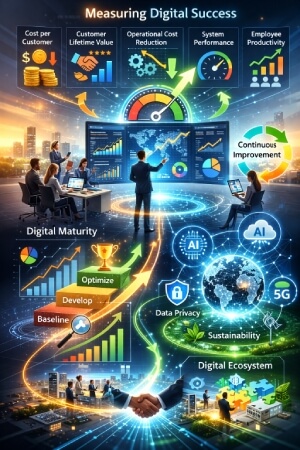
Platforms to analyze data allow leaders to monitor results continuously. They use these results to measure the return on investment (ROI) of their efforts on a continuous basis. It creates an environment where there is always room for improvement.
Models to assess your organization's digital maturity also exist. Consulting companies like Accenture and PwC have developed frameworks to define what level of digital capability exists within each organization. The models can help you understand your strengths, as well as areas of opportunity for growth.
The future of business innovation has many potential directions in which it can be headed due to continued advancements in the digital landscape (e.g., artificial intelligence) that occur each year; increased accessibility of cloud computing environments; and increasing connectivity via 5G networks.
Innovation in the future is likely to include greater incorporation of artificial intelligence as a component in decision making; enhanced protection of data privacy; sustainable digital practices; and cross-industry partnerships and collaborations enabled by digital ecosystems.
There is growing interest in sustainability. As such, technology companies have been investing in the development of energy efficient data centers. Companies also are measuring their "carbon footprint" for their digital operations. As such, innovation now includes an element of accountability regarding its environmental impact.
Digital ecosystems enable organizations to partner with and share data with their partners, suppliers and customers via shared platforms. Digital ecosystems provide a collaborative environment where businesses may collaborate instead of operate independently from one another. This networked approach to doing business creates additional opportunities for organizational resiliency and adaptability.
Conclusion
The connection between business innovation and the digital world can be made through aligning business strategy with business technology. As business transforms digitally it changes how it does business, with whom it has relationships with customers, and how it differentiates itself from competitors.
The use of tools such as cloud computing, AI, big data analytics and IoT are changing how businesses operate day-to-day.
Digital transformation provides many opportunities for successful innovation, but the success of innovation also depends on the company's leadership, corporate culture and its ability to measure its success. Companies that take an active role in addressing security concerns, complying with regulations and developing their employees have a greater opportunity to experience successful innovation.
While there are still challenges associated with innovation, companies are capable of taking advantage of the numerous opportunities available for innovation. Technology continues to advance at an unprecedented rate. Companies who plan for future innovations responsibly with clear objectives, will be better equipped to address new technologies as they emerge. Businesses that recognize the constant change of the digital world will continually be able to prepare for what comes next.